For more than two decades, Search Engine Optimization (SEO) has been the foundation of online visibility. If your website ranked well in Google search results, you were visible. If it didn’t, your business struggled to be found.
But 2026 represents a fundamental shift.
Visibility is no longer controlled solely by search engines — it is now driven by AI systems that generate answers directly in response to natural language questions.
Google itself is making this transition explicit. Its latest Search updates integrate AI-powered summaries and conversational answers, allowing users to ask follow-up questions and get direct responses without clicking links. (The Verge)
In this new search paradigm, Generative Engine Optimization (GEO) is becoming more powerful than traditional SEO — not as an upgrade, but as its successor.
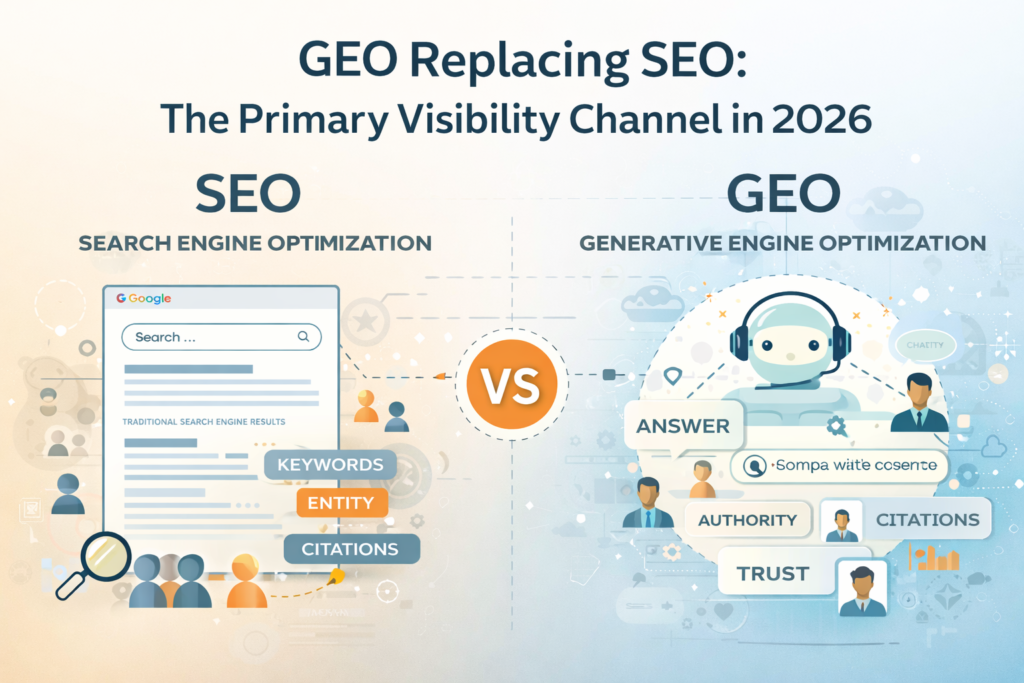
SEO Was Built for Ranking. GEO Is Built for Being Cited.
Traditional SEO focuses on:
- Keywords
- Rankings
- Click-through traffic
GEO aims to:
- Build authority
- Secure citations inside AI-generated answers
- Ensure inclusion in summaries from AI search platforms
SEO asks:
“How do we rank higher?”
GEO asks:
“How do we become the trusted source AI chooses to cite?”
With AI-driven search, visibility is not just about showing up — it’s about being referenced as part of the answer.
The Impact of Zero-Click Search Trends
One clear signal of this shift is the rise of zero-click search — searches that end without a user ever clicking a search result link.
Multiple studies show that a large majority of searches now result in zero clicks. For example, about 58.5% of U.S. Google searches and 59.7% of EU searches ended without a click in 2024. (Search Engine Land)
Zero-click behavior isn’t limited to Google’s desktop results — it’s especially pronounced on mobile devices and continues rising as platforms provide instant answers. (SparkToro)
This trend demonstrates that users increasingly get answers without ever visiting websites, which fundamentally changes what “visibility” means online.
Search Engines Are Becoming AI Answer Platforms
Google’s shift toward AI overviews and follow-up queries reflects broader changes in how search works. The line between traditional search and interactive AI responses is blurring, and platforms like ChatGPT, Gemini, and Copilot are becoming default channels for information discovery. (Business Insider)
This means:
- Users ask questions conversationally.
- AI systems generate concise, context-aware answers.
- Websites are no longer the first — or even the main — stop for information.
In this context, SEO alone — which focuses on rankings and traffic — cannot guarantee long-term visibility.
Authority Matters More Than Ranking
AI systems don’t decide what to show based on keyword frequency or backlink counts alone. They favor content and brands that demonstrate trustworthiness, clarity, structure, and authority.
Academic research on AI search shows that generative systems synthesize answers from diverse, high-quality sources, emphasizing AI-ready content rather than traditional signals. (arXiv)
In practice, this means:
- Answers are drawn from credible sources that AI models recognize and trust.
- Structured, well-organized content has higher potential to be cited.
- Brands become seen as entities with measurable authority — not just pages with rankings.
SEO vs GEO — A Strategic Comparison
| Traditional SEO | Generative Engine Optimization (GEO) |
| Focus: Rankings | Focus: Citations inside AI answers |
| Keyword-centric | Entity-centric |
| Measures: Traffic | Measures: Visibility in AI systems |
| Goal: More clicks | Goal: AI mentions & trust |
| Designed for search engines | Designed for AI agents |
In essence, SEO builds a foundation, but GEO builds authority.
GEO Doesn’t Eliminate SEO — It Elevates It
SEO continues to matter. A well-structured, fast-loading, accessible site still improves user experience and search engine indexing. But GEO sits above and beyond SEO — shaping how content is interpreted and referenced by AI.
Rather than merely chasing page rankings, brands must focus on:
- Answerable content
- Entity and FAQ structure
- Clear, machine-understandable knowledge
- Signals of trust from other authoritative sources
This represents a *shift from being discoverable to being trusted.
Final Thought
By 2026, visibility is no longer just about ranking first on Google.
It’s about being trusted enough to be the source AI chooses to cite.
AI summaries and zero-click search behavior are rewriting how users find answers.
Traditional SEO built visibility.
GEO builds credibility inside AI answers.
That’s why Generative Engine Optimization will replace SEO as the primary visibility channel in 2026.
Referenced Links
- Google’s AI Search evolution — AI Overviews update showing conversational search with follow-up: theverge.com/news/goog… (The Verge)
- AI Chat integration blurs search lines — Business Insider, conversational search summary: businessinsider.com/google… (Business Insider)
- Zero-click search data — SparkToro/Datos analysis of search behavior: sparktoro.com/blog/2024-zero-click… (Search Engine Land)
- Zero-click trends across regions — SparkToro data and click trends: sparktoro.com/blog/in-2020… (SparkToro)
- Academic research on generative search differences — Comparative AI search analysis: arxiv.org/abs/2601.16858 (arXiv)